Global Outlook 2026: The great recalibration
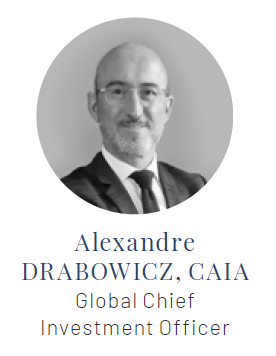
When we gave our 2025 Global Outlook the title ‘A Transforming World,’ we knew change was underway, but we could not have anticipated the sheer velocity of transformation we have since witnessed. Now, as we look toward 2026, one thing is clear: recalibration is needed across the board—central banks must rethink monetary policy, governments must address deficits, companies need to refine their investment strategies, energy systems must adapt to the demands of articial intelligence (AI) and sustainability and we, as wealth managers, must adapt asset allocation to this shifting landscape.
DEGLOBALISATION VS. GLOBALISATION WITHOUT THE US
Over the past few years, global trade has hit a plateau, driven by a convergence of factors: supply chain disruptions, geopolitical uncertainty, and, of course, US tariffs. Yet, the World Trade Organization (WTO) projects global trade growth of 2.4% in 2025—albeit slower than 2024’s 2.8%— before a sharp deceleration to just 0.5% in 2026 due to “unprecedented” uncertainty over trade policies. These figures seem counterintuitive, given the prevailing narratives of deglobalisation.
The truth, however, is less about deglobalisation and more about recalibration. Global trade is not shrinking—it’s evolving. Investments in AI are providing a significant boost, with Asia leading the charge as the US grapples with export restrictions. South Korea, Taiwan, and China are increasingly prominent players in this AI-driven recalibration. Meanwhile, the US is focusing on reshoring, seeking to reduce its trade deficit by bringing manufacturing and investment back home.
As the US retreats, a new wave of globalisation is emerging without it. China is ramping up its efforts to rival American influence by forging trade deals and investment partnerships in Africa, Latin America, and across Asia. Together, these regions represent 85% of the global population—a staggering figure that underscores the scale of this recalibration.
DE-DOLLARISATION VS. A NEW CURRENCY ORDER
As Henry Kissinger is often believed to have said, “He who controls the currency controls the world”. For decades, international investors poured trillions into US assets, often without factoring in currency risk. But 2025 marked a pivotal shift. While the US administration is not explicitly advocating for a weaker dollar, it is calling for a realignment of currency dynamics, citing manipulation as a barrier to fair competition. The irony? The very nations funding the US deficits are now realising they hold an overabundance of dollars.
The US dollar’s outsized role in global trade, reserves, and exchange markets is increasingly being challenged. Three emerging themes are reshaping currency dynamics and could define the next decade:
- First, central banks are doubling down on their diversification strategies. 2025 marked the fourth consecutive year of non-stop gold buying, signalling a clear intention to reduce reliance on the dollar.
- Second, China is attempting to position the renminbi as a viable alternative for international trade and reserves. Bilateral trade agreements and financial partnerships are proliferating, with Kenya being a notable example—it recently proposed issuing renminbi debt, cutting its borrowing costs in half. Other developing nations are likely to follow suit.
- Third, investors are adjusting their portfolios to hedge against dollar weakness. The sharp increase in currency hedging reflects a broader reassessment of exposure to the greenback. While US assets remain attractive, investors are recalibrating their approach to mitigate currency risk. Expect this trend to accelerate in 2026 as global portfolios undergo further refinement.
DEFICITS VS. INVESTMENTS
The ballooning deficits of Western governments remain a central concern. The US Congressional Budget Office estimates that total US debt will soar to 53 trillion dollars by 2035. Tariffs could offer a short-term fix, with Yale’s Budget Lab projecting 2.4 trillion dollars in tariff revenue over the next decade, but this approach is fraught with uncertainty and is far from a sustainable solution.
Meanwhile, Germany is adopting a bold strategy, committing 1 trillion euros to investment over the next decade. Rather than fixating on deficits, it is recalibrating fiscal policy to prioritise infrastructure, technology, and European strategic autonomy. This forward-looking approach is not only welcome but necessary, as it sets the stage for long-term growth and strategic autonomy.
Capital markets are undergoing a similar shift. For the first time, the issuance of “Yankee debt” (US-dollar-denominated debt by non-US corporates) is slowing, while “reverse Yankee debt” (euro-denominated debt issued by US firms) is rising. This presents a significant opportunity for Europe to assert a stronger role in global capital markets. Strategic government spending on long-term projects will attract private investment, creating a virtuous cycle of growth and recalibration.
LOOKING AHEAD
I invite you to explore the insights of our Chief Market Strategist, Jérôme van der Bruggen, in the next section, where he outlines our key messages for 2026. Be sure to delve into our “10 Surprises for 2026,” where investment heads across our international footprint share their perspectives on potential shocks—both positive or negative—and their implications for portfolio strategies.
This new edition of the Global Outlook is intended to serve as a valuable resource, helping you recalibrate your perspectives and shape your port-folio in this ever-evolving investment landscape. Together, we can navigate the complexities of this fascinating world of transformation and opportunity.
December 08, 2025